
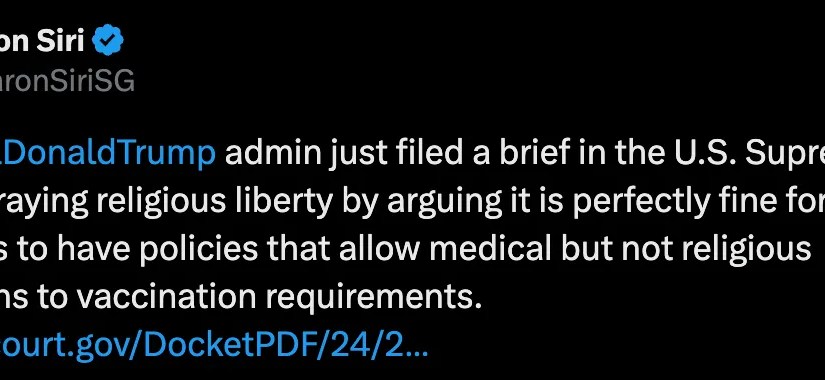
DOJ risks setting precedent that treats people of faith as ‘second-class’ in “sharp betrayal” that could erode religious freedom for millions of Americans, says leading litigator arguing for religious freedom.
The Trump administration wants American workers stripped of their ability to claim religiously based exemptions to vaccine mandates forced upon them by their employers. Yes, you read that right.
Trump’s U.S. Department of Justice filed a brief last week before the U.S. Supreme Court arguing that employees should be able to claim medical exemptions but not religious ones. Accommodating a person’s religious exemption from a vaccine mandate is just too big of a “hardship” on corporate employers, the adminstration argued, even as it acknowledged that medical exemptions were perfectly OK and reasonable for employers to accommodate.
This is just the latest example of Trump’s non-stop kowtowing to the demands of corporate America, to the detriment of us working stiffs. He will seemingly go to any length to back the interests of big business, whether it’s offering Big Ag and Big Pharma legal protections for their poisonous foods or cancer-causing products, to encouraging them to blanket America with unhealthy data surveillance centers, or allowing them now to force people to get vaccines against their sincerely held religious beliefs, Donald Trump has become a prostitute for the billionaire Epstein class.
Below is an excerpt from veteran health reporter Jeffery Jaxon’s May 27 article on the latest betrayal of the American worker.
In a stunning reversal the Department of Justice under President Trump has filed a brief urging the U.S. Supreme Court to deny review in John Doe et al. v. Kathy Hochul, No. 24-1015. The case involves former New York healthcare workers fired for refusing COVID-19 vaccination on religious grounds under the state’s now-repealed Section 2.61 mandate, which allowed medical exemptions but barred religious ones.
The move is in stark contrast to the COVID-era legal momentum across the board seeing courts rule in favor of employees fired for religious vaccine refusals.
The Second Circuit upheld the employers’ refusal to accommodate, citing “undue hardship.”
The DOJ’s Call for the Views of the Solicitor General brief argues the petition is a poor vehicle for review—no circuit split, a repealed law, and petitioners who sought only a full exemption rather than alternatives like reassignment—while defending the policy’s consistency with Title VII of the Civil Rights Act.
This position, however, draws sharp criticism for weakening core protections against religious discrimination. Aaron Siri, a leading litigator who has represented numerous affected healthcare workers, called out the filing in an X post stating:
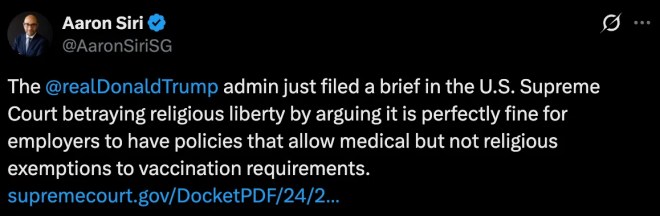
The brief’s analysis hinges on semantics and procedural technicalities. It acknowledges that petitioners claimed New York’s mandate conflicted with Title VII (of the Civil Rights Act) by foreclosing reasonable religious accommodations. Yet it frames their requests as demands for an “exemption” prohibited by state law, rather than the “accommodation” that federal law requires.
Siri dismantled this in a follow-up post:
“Instead of defending these wrongfully terminated workers, the DOJ nonsensically and shamefully plays word games to characterize their requests as seeking an ‘exemption’ (which New York law prohibited) instead of an ‘accommodation’ (an option federal law requires). It then relies on this semantic nonsense to argue that the Supreme Court should not review the Second Circuit’s holding that a policy providing for medical but not religious exemptions is legal.”
Siri, who is perhaps the most experienced lawyer defending Americans who experienced COVID-era oversteps of basic liberties and freedoms, described the practical outcome bluntly: the mandate “permitted only a medical exemption and did not include a religious exemption.”
Healthcare workers with sincere religious objections were fired en masse. He continued:
“Having dealt with scores of religious employees in New York that lost their jobs under this policy, the Trump administration’s position is a sharp betrayal. The DOJ should have simply argued the obvious – that Section 2.61 foreclosed any religious exemption and hence should not stand under federal law. Period. That would have taken one or two pages. Instead, it spends over 20 pages creating a word salad of nonsense to justify New York’s and the DOJ’s unjustifiable position.”
This approach is dangerous because it normalizes differential treatment: medical exemptions are permissible, but religious ones trigger “undue hardship” claims tied to state penalties.
If a law bars religious accommodations outright, Title VII should preempt it—yet here the filing accepts a policy that functionally did exactly that while claiming otherwise.
The stakes extend far beyond healthcare. A Supreme Court denial, influenced by this brief, could embolden employers nationwide to impose vaccine or other medical mandates while dismissing religious objections as unreasonable.
It undermines the free exercise principles reinforced in cases like Fulton v. City of Philadelphia and signals that post-COVID religious liberty battles remain unwinnable in court. Workers facing future mandates—for flu shots, boosters, or novel therapies—would find their faith subordinated to bureaucratic convenience.
Siri’s critique highlights a missed opportunity for the administration that campaigned on restoring freedoms eroded during the pandemic. By playing procedural games instead of forcefully defending Title VII’s mandate to accommodate sincere religious practice, the DOJ risks setting precedent that treats faith as second-class. As Siri warned, this is no minor technical brief; it is a “sharp betrayal” that could erode religious freedom for millions. The Supreme Court must recognize the broader threat and take the case to reaffirm that no employer or state can lawfully force a choice between livelihood and conscience.
My independent reporting is funded solely by my readers, so please consider making a donation of any size to my GiveSendGo. Those preferring to send a check can do so c/o Leo Hohmann, P.O. Box 291, Newnan, GA 30264. Thank you for the much-needed support.


Sorry for the multi-posts. I’m not sure what happened.
LikeLike
Interesting timing. Especially since the US government has decided to cooperate with Gavi again as it relates to finding an Ebola vaccine. Perhaps it’s coincidence. Supposedly Trump pushed for the rehire of the service members who were discharged from the military over their refusal to take the COVID vax. I don’t know if that actually happened or not. But that is certainly going against that decision if so.
LikeLike
Interesting timing. Especially since the US government has decided to cooperate with Gavi again as it relates to finding an Ebola vaccine. Perhaps it’s coincidence. Supposedly Trump pushed for the rehire of the service members who were discharged from the military over their refusal to take the COVID vax. I don’t know if that actually happened or not. But that is certainly going against that decision if so.
LikeLike
Interesting timing. Especially since the US government has decided to cooperate with Gavi again as it relates to finding an Ebola vaccine. Perhaps it’s coincidence. Supposedly Trump pushed for the rehire of the service members who were discharged from the military over their refusal to take the COVID vax. I don’t know if that actually happened or not. But that is certainly going against that decision if so.
LikeLike
No religious exemptions for vaccines yet you can get them for special foods in schools, religious prayer rooms in government buildings and religious exemptions to broadcast loud obnoxious calls to prayers. But only of course for one specific people. Surely Mr. Trump this is hypocritical and discriminatory. Ain’t it?
LikeLike
Well the ardent supporters of Trump are finding out he isn’t what they thought he was. But when you place your trust in any politician, you will find out all of them are the same-they say whatever they think people want to hear to get elected and then follow the directives of those who really have control over them-those with big money.
Yet if Kamala Harris had been elected we know how much worse things would be. The problem is we don’t have people with integrity and principles that can’t be compromised would ever want to be in politics.
LikeLike